Query Fan-Outs: the Searches AI Runs Before It Answers You
Before ChatGPT answers a question about your category, it usually googles it — literally. The engine breaks your buyer's prompt into its own web searches, reads what comes back, and builds the answer from that. Those intermediate searches are called query fan-outs, and here's the part that took us too long to appreciate: several engines expose them, verbatim, in their tool calls. Which means you can stop guessing what to optimize for and read the actual queries deciding whether you get cited. We've been capturing them for months. This is what they look like.
By Philipp Enders·Founder, CrunchJunkie·LinkedInBuilds the reporting and AI-visibility tooling this analysis was run with.
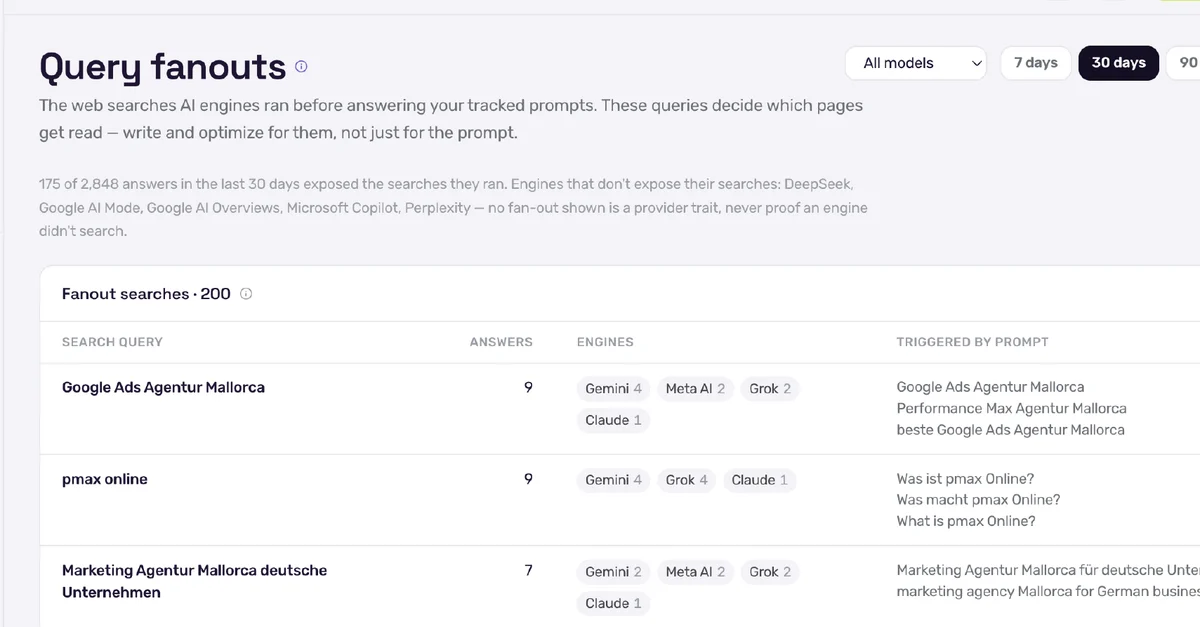
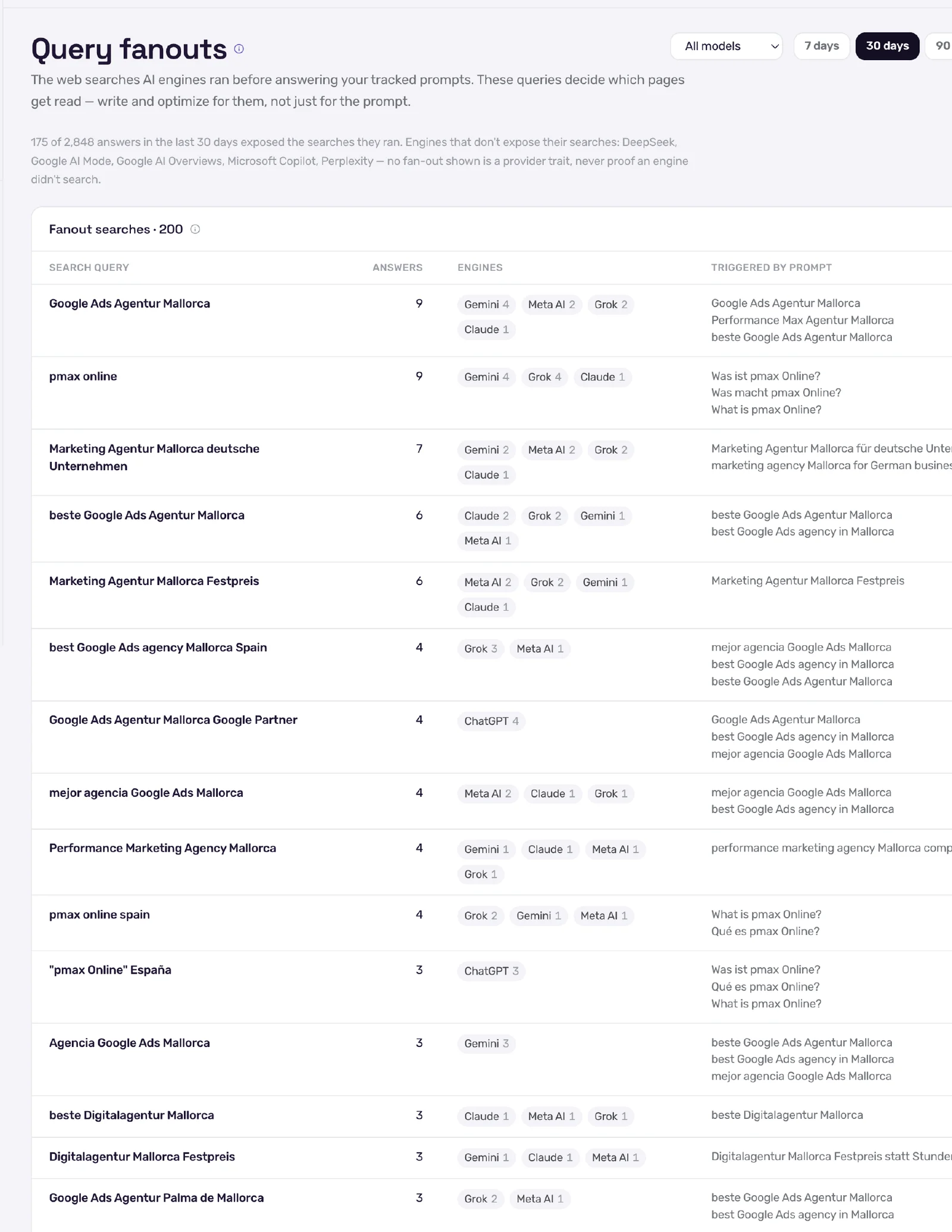
One project's fan-out table: every row is a web search an engine actually ran, captured verbatim from its own tool calls — with the prompts that triggered it.
What a fan-out is, concretely
Take the prompt "best AI brand visibility tools for marketing agencies." When Claude received it in one of our scans, it didn't answer from memory — it searched the web for "best AI brand visibility tools for marketing agencies 2026", read the results, and composed its answer from what it found. Sometimes one prompt fans out into four or five searches from different angles: a category search, a pricing search, a reviews search, a comparison search.
The pages that get read — and therefore the pages that can get cited — are the ones that rank for those intermediate searches, not necessarily for the prompt itself. That reframes the optimization target. Everyone in this industry writes content for imagined prompts. The engines are telling you, in plain text, what they actually query. The difference between the two is where citations are won and lost.
Two hundred searches from one project
Over 90 days of scanning our own brand, 129 of 244 answers exposed the searches they ran — 200 distinct queries. Reading them is humbling, because they are better market research than most paid tools produce. The engines searched "best AI brand visibility tools for marketing agencies 2026", "AI visibility tool white label client reporting agencies", "how agencies report AI search visibility to clients", "free tool to check brand AI visibility ChatGPT", "AI visibility tools scraping ChatGPT vs API accuracy", "track AI answer mentions SKU product level tool".
Every one of those is a question a real buyer has, phrased the way a machine researches it. And next to each row sits the sobering column: how many of those answers cited us. For most of the commercial searches in this window the answer was none — the citations went to whoever ranked for the fan-out. The engines even researched our competitors' prices while composing comparison answers: "Peec AI pricing" appears twice, run by engines deciding what to say about alternatives. Nobody involved in that transaction visited anyone's marketing page.
Each row is a real search. The engines column shows who ran it; the prompts column shows which tracked buyer questions triggered it.
Every engine searches differently
The capture also shows that the engines have search personalities, and they are distinct enough to plan around.
ChatGPT writes long, descriptive queries and stacks qualifiers — "AI search visibility monitoring multiple LLMs daily brand monitoring United States Profound Scrunch Otterly Peec official". It names brands it already suspects belong in the answer, appends "official" when it wants primary sources, and adds the market it is answering for.
Claude writes compact keyword queries, close to how an experienced human searches — "AI visibility tool white label client reporting agencies" — and appends the year to almost everything commercial.
Gemini is the surprising one: it uses operator syntax. Exact-phrase quotes, OR chains, even site filters — one captured query was "CrunchJunkie" trustpilot OR g2.com OR capterra, an engine explicitly hunting third-party review coverage before deciding what to say about a brand. If you ever doubted that review-platform presence feeds AI answers, there is the receipt.
And three engines have no fan-out at all, by construction: Google AI Overviews, AI Mode and Copilot sit on top of a search engine, so the user's query is the search. For those surfaces the optimization target never left classic search — a point worth its own article, which we wrote here.
The year tax
The single most consistent pattern across engines: the year gets appended. "Best AI brand visibility tracking tool 2026". "AI search visibility metrics to track 2026". "AI search visibility reporting tools 2026 agencies". The engines are deliberately biasing retrieval toward fresh content, which has an uncomfortable implication for anyone whose cornerstone pages read timeless: a page that never signals recency is fighting the engine's own query construction. Dated content, updated dates that reflect real updates, and current-year framing where it's honest are not cosmetic — they match how the retrieval step actually asks.
Where fan-outs meet Search Console
Because fan-out queries are ordinary Google searches, you can join them against your own Search Console data — the exact string, your real position, impressions, clicks. That join produces the single most actionable list in AI visibility: fan-out queries with many answers that didn't cite you, where you already rank on Google. The content exists, Google can find it; the engines read the results and still passed you over. That's not a "create content" problem — it's a make-this-page-citable problem: liftable claims, sourced statistics, current dates.
We had a textbook case in our own data. Engines repeatedly searched "AI visibility tools scraping ChatGPT vs API accuracy" while answering accuracy prompts. We have an entire article on exactly that question — it ranked around position 28 for the matching query in the same window, and not one of those answers cited it. The fan-out told us precisely which page to sharpen and for which literal search string. No keyword tool produces that sentence.
One honesty note, because this is where vendors like to decorate: there is no search-volume number for fan-out queries and there cannot be one — these are machine-generated searches, not human search demand. What you get instead is better: an exact count of how many AI answers, on your prompts, ran each search.
What to do with yours
Three moves, in order of leverage. First, read your fan-out table next to its citation column and sort by answers-without-you — that's your priority list, already weighted by how often the engines actually ask. Second, for each high-leverage query, decide whether the fix is a new page or a citability fix to an existing one; the Search Console join answers that for you. Third, write for the fan-out's phrasing, not just the prompt's — when CrunchJunkie generates a content brief from a gap, it targets the verbatim fan-out queries for exactly this reason.
Fan-out capture runs automatically in every CrunchJunkie scan on the engines that expose their searches. If you want to see what the engines search before they answer about your brand, that table is waiting in your project — and if you're not tracking yet, the free visibility check is the two-minute version of the same question.
Frequently asked questions
When an AI engine receives a prompt, it often decomposes it into its own web searches — several different queries approaching the question from different angles — reads the results, and synthesises the answer from them. Those intermediate searches are fan-out queries. The pages that rank for them are the pages that can be cited, which makes them a more precise optimization target than the prompt itself.
No, and the differences are structural. ChatGPT, Claude and Gemini run and expose fan-out searches in their tool calls. Perplexity and DeepSeek search (or answer from training) without exposing the queries. Google AI Overviews, AI Mode and Copilot have no fan-out at all — they sit on a search engine, so the user's own query is the search. Absence of a captured fan-out is never proof an engine didn't search.
No, and be suspicious of any tool that shows one. Fan-out queries are generated by machines during answer composition, not typed by humans, so no search-volume panel measures them. The honest metric is a count: how many AI answers on your tracked prompts ran that search, and how many of those answers cited you.
You need a tool that captures the engines' tool calls during scanning rather than just the final answer. CrunchJunkie records fan-out queries verbatim on every scan for the engines that expose them, joins each query against your Search Console data for the exact string, and shows how many answers ran the search with and without citing you.
See your AI visibility on your own brand
Reporting and AI search visibility in one console — run your first report and scan inside the 14-day free trial.